


Directed: Aisling Walsh
Written: Peter Ransley (from the novel by Sarah Waters)
I will admit that Fingersmith was many people’s favourite Sarah Waters book and film adaptation, but I will say it was not mine. That is my caveat!
Sarah Waters has had a fabulous run when it comes to having her books adapted for the screen. First came the lavish production of Tipping the Velvet which truly captured the spirit of the book, even if the filmmakers chose to make some key changes. Fingersmith was the second BBC production of a Sarah Waters novel. While I'm not as willing to wax rhapsodic about this production as I was about Tipping the Velvet, it was a solid, engaging story and a beautiful visual experience.
As with all films that involve a mystery of some kind, to outline too much of the plot is to do both the film and the audience a disservice. In broad terms, Fingersmith follows the story of Sue Trinder (Sally Hawkins) and Maud Lilly (Elaine Cassidy), two young women who are caught up in a scheme twenty years in the making. At the behest of a con man named "Gentleman" (Rupert Evans), and with the encouragement of her foster-mother Mrs Sucksby (Imelda Staunton), Sue agrees to help in a plan to rob Maud, a young, wealthy girl who lives at the country estate of Briar.
Maud Lilly, who lives alone with her eccentric uncle, is due to come into her inheritance of forty thousand pounds when she marries. However, Mr Lilly keeps her so locked up and isolated as to negate the possibility of that ever happening. Gentleman proposes to pose as Mr Richard Rivers, a suitor for Maud and an employee of her uncle, while Sue poses as Maud's maid. Her role in the con is to convince the naive, impressionable Maud that she is in love and ought to run away and marry Rivers. After that has happened, Rivers will have Maud locked up in an asylum and take her cash for himself. Sue's share in the booty will be three thousand pounds.

Of course, if the scheme went exactly as planned there would be no story. Things start to go awry when Sue and Maud begin to develop feelings for one another. The unravelling of the con and the unveiling of the characters' different motivations forms the bulk of the plot.
Fingersmith must have been an extremely difficult tale to adapt, considering the backpedalling, twists and turns the plot takes in the novel. The first episode takes its time to unveil the growing feelings between the two girls and concentrates solely on telling the first third of the novel in exquisite detail. Unfortunately this left the other two-thirds of the book—the part of the novel that contains most of the action, plot twists and revelations—to be told in just one episode. The langorous pace of episode one makes the second feel rushed. Essentially, mush like TTV, this should have been three parts, not two.
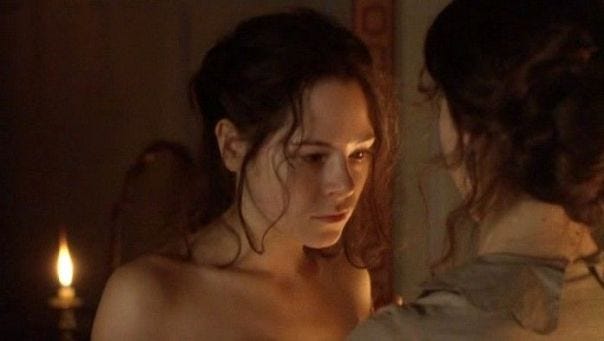
I was disappointed at the lack of development of the minor characters. I think this is where the Tipping the Velvet adaptation shone, because even the smallest of the characters introduced were three dimensional. The inhabitants of Mrs Sucksby's house lacked colour, nor did we get to see much of the sanctimonious inner-workings of the inhabitants of Briar, or the devilish inmates at the madhouse.
I understand the story concentrates on the main characters by necessity, but with so little attempt at exploring their surroundings the settings the two girls existed in weren't as alive and vibrant as I remembered from the amazing novel. Ignorance will be bliss for people who have only seen the movie, but I felt cheated.
While there is no doubt Maud and Sue were perfectly cast, they could have used a bit more imagination with the casting of Gentleman. For such a pivotal role, Rupert Evans did not have the subtlety and finesse to play a good con man, and Evans seemed to respond to every situation with the same overly-affected, sour expression.

Where Fingersmith excels though is in breaking down the story into its smaller elements—exploring the nature of love, guilt, yearning, greed and passion. How thin is the line between love and hate? What crimes are beyond forgiveness? This adaptation succeeds in getting right to the emotional heart of the story.
Fingersmith will satisfy incurable romantics and lovers of tortured love stories everywhere. Not a single opportunity was missed to drive home the lingering effect the brief love affair had on the two girls. The strength of that memory powers all their thoughts and actions for the remainder of the film—much more so than any anger or thirst for vengeance.
As Sarah Waters herself said, the story is a diabolical delight, and well worth a lovely Sunday afternoon of indulging in BBC costume drama. Afterwards though you could dig up The Handmaiden, based on the same story, for an interesting juxtaposition.