

possession
Film, 2002, 4 stars
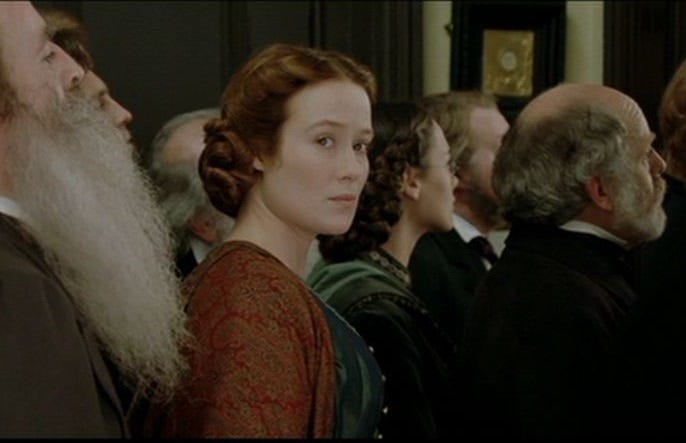
Directed: Neil LaBute
Written: David Henry Hwang
I have never understood the critical drubbing this film received. It was a monumental task, taking something so sprawling and rich as A.S Byatt's novel and transforming it into a film for modern audiences used to much faster-paced fare.
The novel is huge, both in length and thematically, and there are many aspects of it that are simply not cinematic. To adapt is to transform a text for the new medium. I think that, all things considered, the writers have done a pretty good job here.
Roland (Aaron Eckhart-who admittedly is a bit dull) is a scholar of Randolph Henry Ash (Jeremy Northam), former poet laureate who was famed for his fanatical devotion to his wife. During the course of his research, Roland uncovers proof of an infidelity, and goes on a hunt through the remnants of history to find out who the woman may have been.
A series of historical coincidences leads him to believe the woman is lesbian poet Christabel LaMotte (Jennifer Ehle). He teams up with sceptical LaMotte scholar and Christabel's descendent Maud Bailey (Gwyneth Paltrow) to find out the truth.
Told in a series of flashbacks, the Ash/LaMotte affair is gradually revealed. The modern day scholars are swept up in tracing the path of a past love, only to find themselves becoming inevitably attracted to each other in the process.
Two things. I agree with other critics that the excising of Roland's motivations from the screenplay is confusing. We really don't understand Roland's emotional detachment (he explains it in the film merely as having been hurt before), Maud's coldness, or the phenomenal literary significance of the discovery that the film's narrative centres around. We are required to take these things on faith, and sometimes it is a bit too much to ask. If you’ve read the book you float past this.
Also, this film received an absolute drubbing from lesbian critics. I can appreciate the disdain of seeing one more dead lesbian (LaMotte's distraught partner, played with conviction by Lena Headey), and one more woman "rescued" from her alternative sexuality.
I have an alternative view. If the filmmakers (and the author herself) would have just stopped using the word "lesbian" all the time this would have been much better. Christabel is not a lesbian. She is a woman with passions, who chooses to follow rather than repress her desires, whatever form they take. She is clearly bisexual, and this is as refreshing a view of bisexuality as I've ever seen in a period film.
In Possession what we do get is a fascinating reversal of what we usually see in romantic fiction. In our modern day lives we are supposed to be living in a time of sexual freedom, but that freedom here is buried underneath a mountain of sexual politics. The Victorian-era was supposed to be repressed, but the natural secrecy of the time provided the perfect cover for acting out one's wildest passions.
Here the Victorian lovers provide all the sensuality that their modern day counterparts lack, thus revealing them as cold, unfulfilled human beings. Our Victorian lovers turn to their undeniable passion as the only excuse for doing the inexcusable, which is to betray their spouses and embark on this affair.

Christabel is feisty, warm and sensual, and this is another wonderful period portrayal from Jennifer Ehle, having imbued Elizabeth from Pride and Prejudice with so much energy and life in the 1996 remake. Though she is in danger of being typecast as a corset-wearer, she is the picture of what I imagine a Victorian-era independent woman should be like; buxom, luscious and witty, rather than tight-lipped and thin-waisted as much of film history would have us believe.
By contrast, Gwyneth Paltrow sheds her usual smugness for the role of a repressed scholar of poetry. Maud is only just figuring out that immersing her life in her work, without feeling any of the romance of what she is studying, is missing half the point. As the film unravels so does Maud, emerging tentatively from her shell rather like a turtle sticking out it's neck, expecting it to be cut off.
An ex-lover of Maud's refers to her as the "ball-breaker", presumably because she believes in all the feminist ideology she has studied. I believe we're meant to suspect her studies of a lesbian poet have contributed to her obvious distrust of men. I was glad to see this pointless stereotype thrown out quite early. Maud, like Christabel, is independent yet trapped; Maud by her own boundaries and insecurities, and Christabel by the times in which she lives.
Possession is an intriguing and enjoyable film. It is for people who like their onscreen romances to be complex, sexy, and intelligent. A sexually ambiguous, tortured soul and free thinker, Christabel LaMotte will always be one of my favourite literary characters. Now, thanks to Ehle, she has also become one of my favourite cinematic heroines.