

salmonberries
Film, 1991, 3 stars
Directed by: Percy Adlon
Written by: Felix O. Adlon and Percy Adlon
As much respect as I have for kd lang as a recording artist, I can understand why, after making this film, she decided to leave acting alone and concentrate on what she does best.
That being said, the mess that is Salmonberries is not kd lang's fault. In her acting debut kd turned in a perfectly serviceable performance, made all the more impressive by the fact that the motivations for her character were extremely difficult to understand.
kd lang plays Kotzebue, an orphaned woman who has no idea who her parents were. Kotzebue was left in a cardboard box and raised by a gruff old man without the capacity for affection. In an effort to find out more about herself, she visits the public library in her small Alaskan community. There she meets Roswitha, the secretive, German librarian.
Kotzebue is dressed in such a way as to, I assume, hide her gender. At first Roswitha mistakes her for a boy, especially since Kotzebue rapidly develops a painful crush on the older woman. But is this love, or merely a misguided attempt to secure a type of maternal affection?
As their friendship develops Roswitha begins to realise that she and Kotzebue have something in common. Whereas Kotzebue has no past she has rejected her own, and comes to understand that while Kotzebue's situation is likely never to change, she has a chance at redemption. The scene shifts from the frozen wastes and chiaroscuro lighting of Alaska to the warmer brown and yellow hues of Berlin. The setting is desperately sparse throughout, as are the relationships that occur within it.
The two women tremble on the edge of a love affair. In the warmest and most interesting scene, Kotzebue, perhaps sick of Roswitha's inability to see her as a woman, strips naked and reveals herself, literally, for who she is. It is a desperate attempt to secure a love she can never possess. Roswitha loves Kotzebue it is certain, but at times it seems she loves her with the condescending affection one would show to a favourite pet.
Kotzebue is innocence personified. She's so emotionally raw that she hasn't learned how to handle even small shifts in her emotional state, much less the wild swings that Roswitha inspires in her. She's primal, the beauty of her responses serve to thaw the frosty Roswitha to the point where at least friendship and mutual understanding is possible. But how do you feel sexual desire towards someone who is little more than a child? It is impossible. At times I wondered if Kotzebue might actually just be a symbol of innocence lost, a figure of Roswitha's mourning, tortured imagination.

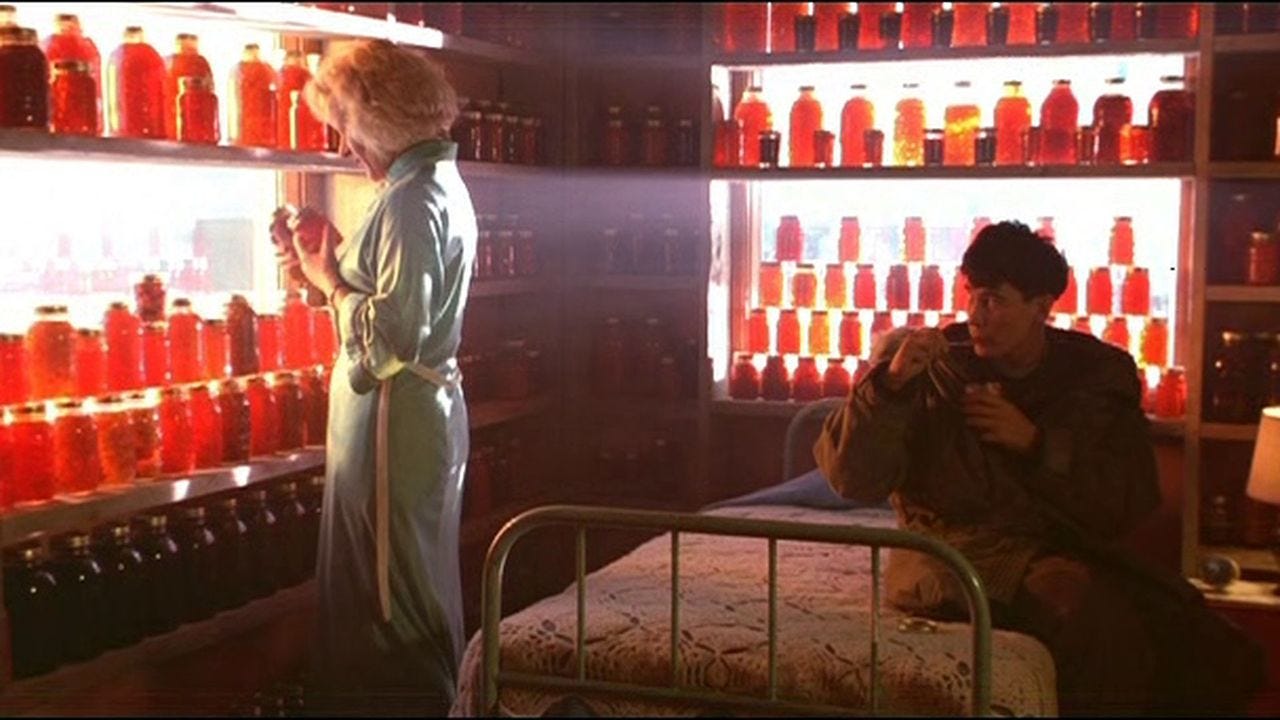
Salmonberries concentrates very much on its own artistic merit. The sets and locations have been built and chosen with love and an exquisite eye for detail. The cinematography, particularly in the use of colour and deep focus, is breathtaking. In Alaska, the camera sweeps across the ice slopes like a lover's gentling hand. Add to this the almost mesmerising strains of the film's theme song "Barefoot" sung by kd lang, and you have enough beauty to lull you into a state of serenity.
Unfortunately, this state of serenity is never really interrupted by the characters or the story. After watching I know quite a bit about the hazards and pitfalls of life on the Alaskan glaciers, but I know next to nothing about Roswitha and Kotzebue. They are both seekers, and for a while they join forces to seek together, but when the film ends we have no sense that they even know what they were really looking for, much less have any inkling of whether or not they found it.
I've heard some say they thought the film was funny, but anything remotely amusing was quickly swallowed by the film's hollow starkness. The script is bare to the point of being nonsensical. The two main characters are as remote, cold and distant as the Alaskan tundra on which the majority of the film is set. While this does serve some metaphorical purpose, it keeps the film at such an arms length from us that we must wrestle to engage with it.